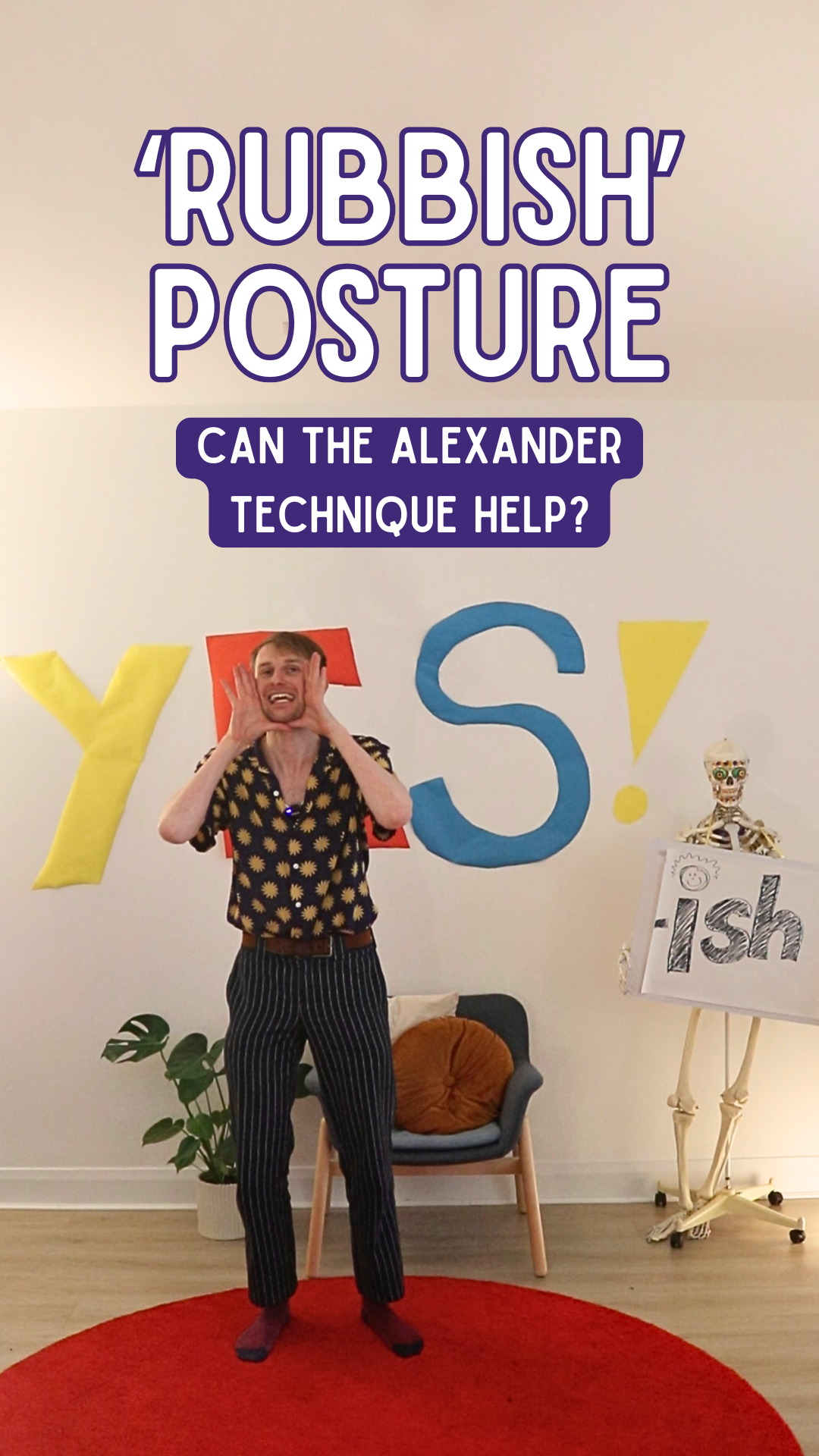
Can the Alexander Technique Help My Posture?
This is a question I get asked (enough that it bares considering): “Can the Alexander Technique help my posture?”
And the short answer is:
A loud and clamorous Yes! …Ish.
A joyful, full throated… sort of.
A beaming, transcendent… kinda.
Obviously this is terrible for marketing and leads to more confusion, and makes me an exhausting person to talk to at a party, however it is unfortunately the most honest answer.
In terms of the “yes”-ness of this answer, one of the benefits of having AT sessions is that your posture will improve. Personally I arrived at the door of my first AT sessions a stressed-out, pain-wracked pretzel, but look at me now! I’M A BAGUETTE!! Years of viola playing had left me stooping and sore and at the age of 18 my knees were starting to ache after climbing the stairs.
Now I can gambole up a flight of stairs with reckless abandon.
So why can’t I just say that AT helps your posture? I’m so glad you asked, I’m now going to tell you why…in great detail.
The Problem With “Good Posture”
It seems to me that “posture” and especially “good posture” has static connotations in culture today. I feel that “Good Posture” is seen as a position that you can achieve, which means that if you’re not achieving it then your posture is “bad”.
But my now-lubricated knees want you to know that human beings are not static creatures. In fact the living reality of the human muscular-skeletal-endochrinal-fascial (just say body) system is far from static.
We are moving, breathing, balancing, reacting, thinking, perceiving beings. Even when we appear still, there’s constant movement happening within us: breath, heartbeat, shifting weight, subtle muscular adjustments, thought, emotion.
So approaching posture as simply a matter of “standing up straight to find correct alignment” is anathema to the lived experience of an embodied human being.
Posture Is Social
Our posture isn’t a purely physical phenomenon. There are social elements to the process of learning how to move through the world.
As children we learn through mimicking how our parents move, how our friends move or how our teachers instruct us to move at school. We learn what confidence looks like, what attentiveness looks like, what attractiveness looks like, what “good behaviour” looks like.
A lot of us grew up being told to:
“Sit up straight.”
“Don’t slouch.”
“Stand properly.”
Perhaps these instructions carry emotional weight, perhaps they encourage us to tighten ourselves?
For this reason, I think posture can become less about ease and coordination, and more about performance. About trying to appear confident, capable, attractive, obedient, or in control.
From Posture to Poise
This is why many Alexander Technique teachers prefer the word poise over posture. For instance I would highly recommend checking out the Poise Project.
Poise has a different feel than posture. It opens us up to sensitivity and responsiveness, rather than rigidity. It invites quiet regulating movement rather than stillness. Ease rather than effort.
Thinking of Poise encourages the idea that, as embodied human beings, we are in a constant dynamic relationship with gravity, the space around us and the people in it.
If, as I believe, we all have inherent poise from the day we are born, each of us has access to an inherent effortless ease, no matter what life might send our way. Through considering our innate capacity for poise, AT sessions help us to discover the postural patterns we’ve unconsciously built over the course of our lives that might be restricting our poise.
Not so we can force ourselves into a better position, but so we can safely explore what it would be like to exist in the world unbound from these constricting patterns.
So… Can AT Help Your Posture?
Undoubtedly yes. People often notice they stand taller, move more freely, breathe more easily, and experience less pain after working with the Alexander Technique.
But ideally, what develops isn’t simply “better posture.” Instead AT hopes to raise awareness of the relationship you have with yourself. And quite frankly? That’s far more interesting than simply standing up straight.
If you’re curious about the Alexander Technique, whether for posture, pain, performance, stress, or simply feeling more comfortable in your own body you’re very welcome to book a £10 1:1 taster session with me. And if anything here raises questions, please do not hesitate to get in touch. (I really love talking about AT…)
And if you are more of a visual/auditory person please enjoy this silly video on the same topic: